

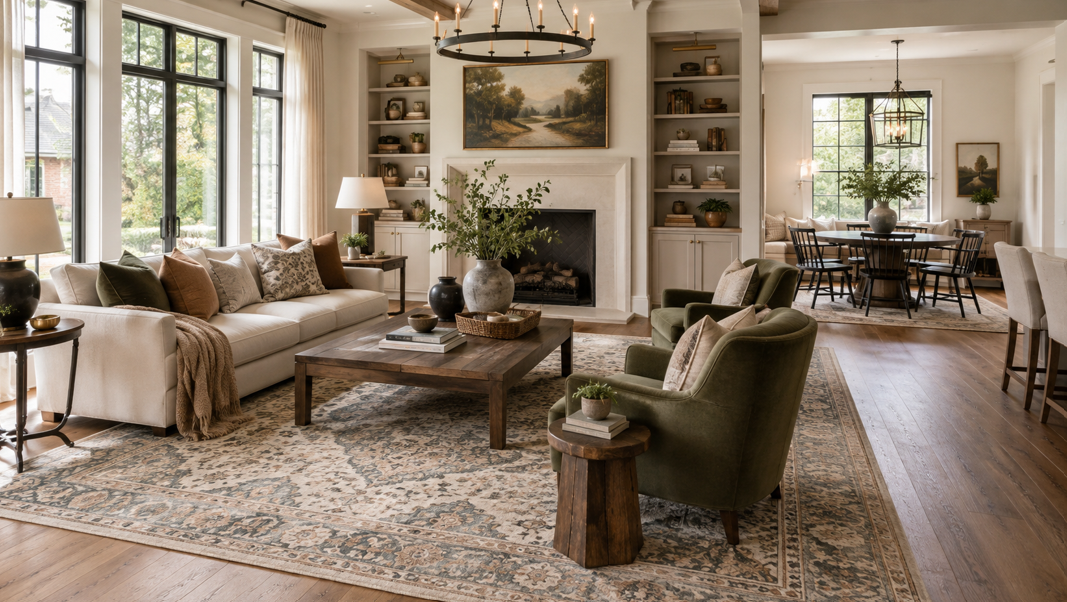
An area rug can completely change how a room feels without changing its architecture. It can make an open living space feel more intimate, bring warmth to hardwood or stone, connect colours across a room, introduce pattern, soften acoustics and help furniture feel intentionally arranged rather than simply placed.
That is why choosing an area rug should involve more than finding a pattern you like.
The right rug establishes proportion, creates visual boundaries and helps different elements of an interior relate to one another. Its size, shape, texture and placement all influence whether a room feels balanced, comfortable and complete.
For homeowners in Nashville, area rugs are particularly versatile because they work beautifully with the mixture of design styles found throughout Middle Tennessee — from traditional Southern interiors and historic homes to modern farmhouse spaces, contemporary renovations and relaxed family rooms.
With more than 30 years of design-focused flooring experience in Middle Tennessee, Floorz helps homeowners think about rugs as part of the complete room rather than an accessory added after every other decision has been made.
Why Area Rugs Matter in Interior Design
An area rug occupies a large amount of visual space.
Even though it sits beneath furniture, it can influence almost everything around it. The colour can connect upholstery with artwork. A border can reinforce the shape of a seating arrangement. Texture can make a sleek room feel warmer, while pattern can give a simple space more personality.
Perhaps most importantly, a rug creates a visual foundation.
Without one, individual furniture pieces can sometimes appear disconnected, particularly in larger rooms or homes with open floor plans. A thoughtfully sized rug gives those pieces a common surface and helps establish them as one intentional arrangement.
Area rugs can also provide practical benefits by:
adding softness beneath the feet;
protecting hard-surface flooring in busy areas;
helping reduce noise and echo;
making large rooms feel more comfortable;
creating visual divisions within open spaces;
introducing colour without permanent renovation;
providing warmth over hardwood, stone or tile; and
making furniture layouts feel more cohesive.
A successful rug therefore works both visually and functionally.
Start With the Purpose of the Room
Before considering colour or pattern, ask what the rug needs to accomplish.
In a formal living room, the primary purpose may be to create a sophisticated visual anchor.
In a busy family room, comfort and durability may be equally important.
A dining-room rug needs to work with chairs being moved regularly. A bedroom rug should make the space feel softer and more comfortable. In an entrance or hallway, construction and ease of care become particularly important.
Thinking about function first immediately narrows the choices.
Ask questions such as:
How much foot traffic does this room receive?
Will children or pets use the space frequently?
Is food regularly served here?
Does the room need more colour or more visual calm?
Is the rug mainly decorative, or does it also need to protect the flooring underneath?
Once those questions are answered, material, pile height, construction and pattern become much easier to evaluate.
Size Is One of the Most Important Design Decisions
A beautiful rug in the wrong size can make an otherwise well-designed room feel awkward.
One of the most common mistakes is choosing a rug that is too small.
A small rug floating in the centre of a large seating area can visually separate the furniture rather than bringing it together. Instead of making the room feel spacious, it can actually make the entire arrangement feel smaller.
The goal is usually to select a rug that relates comfortably to both the furniture and the proportions of the room.
Before purchasing, measure the room and the furniture arrangement rather than relying on memory or estimating dimensions in the showroom.
Painter's tape can be especially useful. Marking the intended rug dimensions directly on the floor gives you a clearer idea of how much space the rug will occupy and how it will relate to nearby furniture.
Area Rugs in the Living Room
The living room is one of the clearest examples of how a rug can define space.
In most seating arrangements, the rug should visually connect the sofa, chairs and tables.
There are several approaches.
All Furniture on the Rug
In a large room, a generous rug can accommodate the entire seating arrangement.
The sofa, chairs and tables all sit completely on the rug, creating a clearly defined conversation zone.
This approach often feels particularly polished in spacious living rooms because the rug establishes one large visual foundation.
Front Legs on the Rug
For many rooms, placing the front legs of the sofa and chairs on the rug provides an excellent balance.
The furniture remains visually connected, while the rug does not need to extend beneath every piece completely.
This is a versatile arrangement that works well in both traditional and contemporary interiors.
A Smaller Central Rug
A smaller rug positioned entirely inside the furniture arrangement can sometimes work in compact rooms.
However, it requires careful proportion.
If too much bare floor separates the rug from the seating, the room can feel fragmented. This is why measuring before purchasing is so important.
Defining Open-Plan Spaces With Rugs
Open-plan homes create an interesting design challenge.
The kitchen, dining and living spaces may share one continuous floor with few physical walls separating their functions. While this creates a spacious atmosphere, it can also make furniture appear to float without clear organisation.
Area rugs can provide those missing boundaries.
A living-room rug visually identifies the conversation area. Another rug beneath the dining table can establish the dining zone. The flooring remains continuous, but each part of the room develops its own identity.
This is especially helpful when the architectural shell is intentionally simple.
The rugs do not need to match exactly.
In fact, identical rugs can sometimes make the interior feel overly coordinated. Instead, look for relationships between them.
They might share:
similar colour families;
complementary patterns;
related materials;
comparable levels of formality; or
one repeated accent colour.
The goal is connection rather than duplication.
Choosing the Right Dining-Room Rug
Dining-room rugs need enough space for both the table and the chairs.
The most important consideration is what happens when somebody pulls a chair away from the table.
If the rug stops too close to the table edge, the back legs of the chair may move off the rug whenever someone sits down. When the chair is pushed back in, the legs can catch against the rug edge.
A more generous size allows chairs to remain comfortably on the rug while being used.
This creates a cleaner appearance and a more practical dining experience.
Construction matters as well.
Dining rooms are usually better suited to rugs that are relatively easy to clean and that allow chairs to move without excessive resistance.
A very deep, plush pile may feel luxurious elsewhere but can be less practical underneath a dining table.
Pattern can also work to your advantage. A detailed design may disguise the occasional small mark more effectively than an extremely pale, solid surface.
Using Area Rugs in Bedrooms
In a bedroom, the rug contributes strongly to comfort.
One of the most pleasant placements allows the rug to extend beyond the sides and foot of the bed, creating a soft surface where your feet naturally land.
The rug can sit beneath the entire bed and bedside tables, or it can begin further down the bed depending on room dimensions and rug size.
Another option is using runners along the sides of the bed, particularly in a smaller room.
The important point is proportion.
A small rug positioned only at the foot of a large bed may look disconnected unless it is intentionally being used as a decorative accent.
A larger rug tends to make the bed feel more grounded and gives the entire bedroom a more complete appearance.
Think About Shape, Not Just Size
Rectangular rugs are the most common choice, but they are not the only option.
A round rug can soften a room dominated by straight architectural lines. It may work particularly well beneath a round dining table, in a reading area or within a circular furniture arrangement.
Runners are useful in hallways, kitchens and other long, narrow spaces.
Square rugs can complement square rooms or furniture configurations with strong symmetry.
The shape of the rug should relate to the geometry already present.
Repeating a shape can reinforce the organisation of the room, while introducing a contrasting shape can soften it.
Neither approach is inherently better. The choice depends on the effect you want to create.
Colour Can Change the Perception of a Room
An area rug is one of the easiest ways to introduce colour on a meaningful scale.
A neutral rug can create calm and allow furniture, artwork and architecture to receive more attention.
A colourful rug can become the starting point for the entire design scheme.
For example, a patterned rug containing muted blue, rust, cream and green might provide colours that can be repeated selectively in cushions, artwork and accessories.
The room then feels connected without every element matching.
Lighter rugs can contribute to an open, airy feeling, although household activity should be considered before choosing very pale colours.
Deeper tones often create warmth and intimacy.
For many Nashville interiors, warm neutrals, earthy colours, faded traditional motifs and natural textures work especially well because they complement both Southern-influenced architecture and more contemporary furnishings.
Pattern Helps Establish Personality
Pattern determines much of the personality of a rug.
Traditional motifs can add heritage and refinement. Geometric designs can create a more contemporary effect. Organic or abstract patterns introduce movement without necessarily feeling formal.
Pattern scale matters too.
A large-scale motif can make a strong statement in a simple room.
A smaller, more intricate pattern often creates visual texture and may work well in a space where the rug needs to coexist with several other decorative elements.
If the room already includes patterned upholstery, elaborate wallpaper or visually active artwork, the rug may need to be quieter.
If the furniture and walls are relatively simple, the rug can comfortably take on a stronger role.
There should be a hierarchy.
Not every element in a room needs to compete for attention.
Texture Is Part of the Design
Colour and pattern are immediately noticeable, but texture can have just as much influence on how a room feels.
A plush rug can make a bedroom or sitting room feel softer and more luxurious.
A flatter weave can provide a cleaner appearance and may be easier to use in areas where furniture moves regularly.
Natural fibres can introduce organic variation, while handwoven construction can add depth and craftsmanship.
Texture can be particularly useful in neutral interiors.
A room filled with cream, taupe and warm grey does not need to feel plain if materials have enough variation. Wood grain, woven fabrics, stone and a textured rug can create richness without relying on bright colour.
Exploring different area rugs in person can make these distinctions much clearer because pile, density, softness and construction are difficult to judge accurately from an image alone.
Consider the Flooring Beneath the Rug
Area rugs do not exist independently from the floor.
The colour, material and grain beneath them influence how the rug appears.
Against warm hardwood, a rug with similar warm undertones can create continuity, while a cooler or lighter rug may introduce deliberate contrast.
Natural stone flooring may benefit from softer textiles that balance its visual and physical hardness.
Waterproof flooring with a wood look can also be complemented by woven textures that make the overall room feel warmer and more layered.
Leaving some visible flooring around the rug usually helps establish this relationship.
The rug should frame the furniture without making the underlying floor disappear entirely.
Layering Rugs for a More Collected Look
Layering rugs can add dimension and personality.
One common approach is placing a smaller patterned rug over a larger, quieter foundation rug.
The lower rug establishes scale while the upper rug introduces colour or detail.
This technique can work especially well in relaxed, layered interiors where the goal is to create a collected rather than perfectly matched atmosphere.
However, layering should still feel intentional.
Consider how the edges relate, whether the upper rug sits comfortably within the larger one and whether the combined thickness creates any practical issues.
Too many patterns or competing colours can make the room feel busy.
As with other design techniques, restraint often produces the strongest result.
Area Rugs and Middle Tennessee Living
Local lifestyle should influence rug selection.
Middle Tennessee experiences four distinct seasons, from wet spring weather and humid summers to busy autumn entertaining and cooler winters.
That means some areas of the home need particularly practical textiles.
Entryways and rooms connected directly to outdoor spaces may see more moisture and dirt. Family rooms need to accommodate everyday activity. Homes with pets require materials and patterns that can handle fur, claws and occasional messes.
At the same time, area rugs bring welcome softness to hard surfaces throughout the year.
During warmer months they add texture without requiring a room to feel heavy, while in winter they provide additional visual and physical warmth.
For households that invest in both comfort and interior design, this flexibility is one of the biggest strengths of an area rug.
Choosing Rugs for Homes With Pets
Pet-friendly design does not mean giving up beautiful rugs.
It simply means choosing with everyday life in mind.
Low- or medium-pile constructions may be easier to maintain in active pet households than very deep piles. Strongly textured loops may need additional consideration if claws are likely to catch.
Pattern can also be practical.
A subtly varied design can disguise small amounts of pet hair or everyday debris better than a completely solid rug.
Colour matters too. Choosing a shade that contrasts dramatically with a pet's coat can make shedding more visible.
An appropriate rug pad can help keep the rug stable and provide an additional layer between the rug and hard flooring.
Regular vacuuming and prompt attention to accidents will also help maintain the appearance of the rug.
The objective is not to create a room pets are afraid to enter. It is to select materials that allow people and animals to enjoy the space comfortably.
Do You Need a Rug Pad?
In many situations, a suitable rug pad is worth considering.
It can help reduce movement, add cushioning and create separation between the rug and the flooring below.
The correct pad depends on both the rug and the floor surface.
Thickness should also be considered. Too much height may create problems near doors or transitions.
A rug pad should support the overall installation without changing the proportions or creating unnecessary trip hazards.
When protecting a particular type of hardwood or finished floor, confirm that the pad material is suitable for use with that surface.
Avoid Choosing a Rug in Isolation
A rug can be one of the largest design elements in the room, which makes it worth considering alongside the rest of the interior.
Bring together samples or photographs of:
flooring;
upholstery;
cabinetry;
paint colours;
window treatments;
stone or tile;
artwork; and
other significant finishes.
A colour does not have to match perfectly to relate successfully.
Often, slightly varied versions of the same colour create a more layered and sophisticated result than exact matching.
Pay attention to undertones as well.
A warm cream and a cool grey-white may look similar individually but feel disconnected when placed next to one another.
Evaluating the rug as part of a complete palette can prevent that problem.
Let the Rug Define the Space
One of the greatest advantages of an area rug is its ability to change a room without permanent construction.
It can visually establish where a seating area begins, turn a bed into a stronger focal point, make dining furniture feel connected or add warmth to an open floor plan.
For homeowners in Nashville, rugs also provide a flexible way to combine traditional and contemporary influences. A vintage-inspired pattern can add heritage to modern furniture, while a clean geometric rug can bring freshness to a more traditional room.
The strongest results come from considering proportion, placement, colour, texture and lifestyle together.
An area rug should not look as though it happened to fit the empty space between furniture.
It should help explain why the furniture is arranged there in the first place.
With more than 30 years serving Nashville and Middle Tennessee, Floorz combines flooring knowledge with in-house design expertise to help homeowners make those decisions as part of the complete interior.
If you are looking for a rug that can bring your room together, visit the Brentwood showroom or contact the Floorz team to explore designs, sizes and styles suited to your home.


